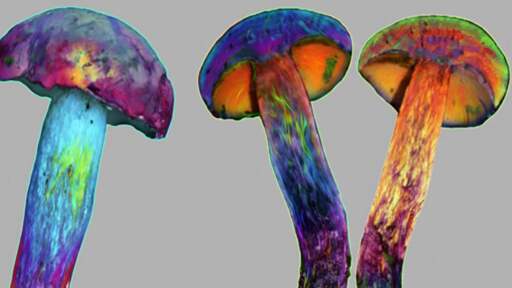
they found no close matches to genes associated with psilocybin or ibotenic acid, two well-known mushroom hallucinogens
None that we already know about, not the same as none
No matter what it is, it is fascinating in its own right that it has such a specific visual effect on users.
Maybe this mushroom was very common once and is the source for folk tales of all sorts.
I mean there are truly a lot of old stories involving tiny people.
They’re just enabling you to see the fae that are always there. DO NOT GIVE THEM YOUR NAME, NO MATTER WHAT!
Well yeah, these guys live there

Maybe it’s not a hallucination at all. Maybe the mushroom is actually an anti-hallucinogen. It suppresses the hallucinations that normally prevent us from seeing the tiny people.
It’s the W-class Mnestic agent in the mushroom.
You will forget everything once you exit the room anyway
Fnord
I suddenly feel uneasy reading these comments after you didn’t post anything.
Now there’s a reference I haven’t heard in a long time.
A long time.
Doesn’t look like anything to me
Knurd mushrooms
Clickbait headline, the primary object of that study was to figure out phylogeny of these mushrooms. finding no known genes associated with known hallucinogens is a bonus and pretty useless info because the compound responsible for this activity is not known, how do you know how it’s made then
“Biosynthetic gene mining of the L. asiatica genome found no close hits with any genes known in the production of mushroom psychoactive compounds,” write the researchers in their published paper.
“This supports our hypothesis of the presence of a novel unidentified metabolite responsible for the unique hallucinogenic properties of L. asiatica.”
Yeah. No known hallucinogens.
Exactly. Or even- no known hallucinogens synthesized by their canonical biochemical pathways by enzymes expressed from the host species genome.
The OG hallucinogen, ergot, is ingested by eating wheat. If one presumed that the substance is made by wheat, and mined the wheat genome, they would never find the genes for its synthesis, because the hallucinogen is made by mold growing on the wheat.
It’s very rare you can draw a strong conclusion from negative results.Rye is the most common place ergot grows, which is another common bread grain. I am not disagreeing with your post, and ergot can grow on wheat too, just pointing out that rye is a much more common source of egot contamination.
I dont really know these things but i always just assumed rye (and barely) was just a kind of wilder less domesticated wheat.
Well it does contain a psychedelic drug, just not one that we’ve identified yet.
It doesn’t need to be, there is reasonable proof that humans and other mammals naturally synthesises (trace amounts off) dmt, which are presumed to be used and broken down incredibly quickly. We still don’t know why, what its used for or have hard proof where its produced (pineal gland is main suspect for having all ingredients in theory)
In theory something could trigger an effect that stops it from breaking down or produce it at a faster rate, therefore triggering psychedelics effects with out the consumed substance containing anything psychedelic itself.
Dmt is known for seeing (machine) elves, does not sound that far away from seeing mini people.
You don’t know that. Maybe it just disables the tiny people filter we normally have.
More fnordposting
that would be a psychedelic drug.
Lanmaoa asiatica

My sincerest apologies. I know the way out.
I had that mower. It’s a good mower. It definitely could do the job.
Wasn’t this part of the plot of the TV show Common Side Effects ?
Good show btw.
Misleading title aside, these mushrooms sound really cool. It’s a shame they’re so hard to find.
Regardless of the actual metabolite responsible, this does raise the question of whether, if any other species consume them and are susceptible, they see tiny versions of their own species?
I always wonder if the cows get high. On the right day it’s like daisies in summer and they’re just munching grass all day.
The psylocibin mushroom specifically grows on cow shit so some of them have to be getting dosed at some point.
I’m referring to libs which do not grow in cow shit.
Now that’s a question. How to test it?
Monkeys seem like a good place to start. Similar enough to us to see if it’s unique to humans, small enough to not start ripping someone’s face off if it goes badly.
Yeah but how do you get an experimental result from them?
Mackaques love touchscreens, amd can be trained to do complex tasks on tablets placed in their enclosures.
You make a test where they need to press a button when and only when they see tiny monkeys that you can project on a screen or on their floor.
Then you give the drug at various concentrations and placebo, and see if there is a dose dependent increase in the monkeys indicaions of mini monkeys.
Then you can repeat the experiment after treatment with antipsychotic, if it prevents the mini monkey reporting, you already have a hint at the mechanism.
Any nonhuman primate lab can do this from 1-2 million dollars, should we start a go fund me?Get one of them sign language moneys and see if they start asking for tiny bananas
Can’t you just ask them? Like train them to show what they are seeing by pointing to one of multiple pictures.
I think you could watch pupil response, body temp, sweating, brain scans, etc and get a good idea.
I thought we were trying to see if the hallucinations of the tiny men changed to match your species’ body shape
Awkward? Unexpected results are the building blocks of science!
We learned a new question to be answered.
Trash headline, but interesting information.
mushrooms are the aliens
you have been astropanspermatogenesis-ed
animals and funghi had a common ancestor about a billion years ago.