

- cross-posted to:
- velo
- cross-posted to:
- velo
You must log in or # to comment.
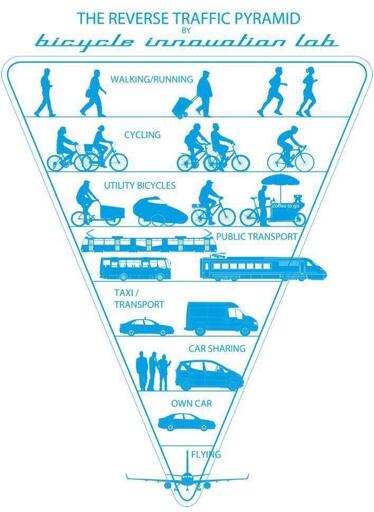
A small nuance is that car sharing is usually better than taxis. A taxi is driving around empty around half the time and has an average occupancy below 1.0. With car share, all the mileage involves moving people to places
I think that’s a regional dependant one in terms of which should be prioritized. There a lot of factors that could lean on way or another.
For example, while Taxis drive around empty, car shares sit around empty. That’s a geometry problem that will be different city to city.
Also, car shares only allow people who can drive (and their passengers) to travel. Taxis can take anyone.
A private car typically sits empty and unused 95% of the time, with all its embodied energy and materials, blocking up 10 square meters of street that might otherwise contain sidewalk or trees.
Thought experiment. Imagine a city where all the car owners sold their cars and took taxis instead. I’m pretty sure this has been modeled and the result is always a massive improvement in terms of resources and space.
Fair comment. On my fantasy mayoral system there’d be no storing cars on public land, so the space issue might be moot
That’s my fantasy too. And I understand it’s roughly the situation in Japan, where urban streets generally do not have parked cars (or sidewalks, alas). It’s because cars are understood to be just another form of private property, to be stored privately. After all, even in the West you don’t just leave your property in a public place, for some reasons it’s only cars. A mind-blowing framing of the problem.
This assumes that the car used for ride-sharing is only ever used with 2 persons or more, which is very much not the case, ever.
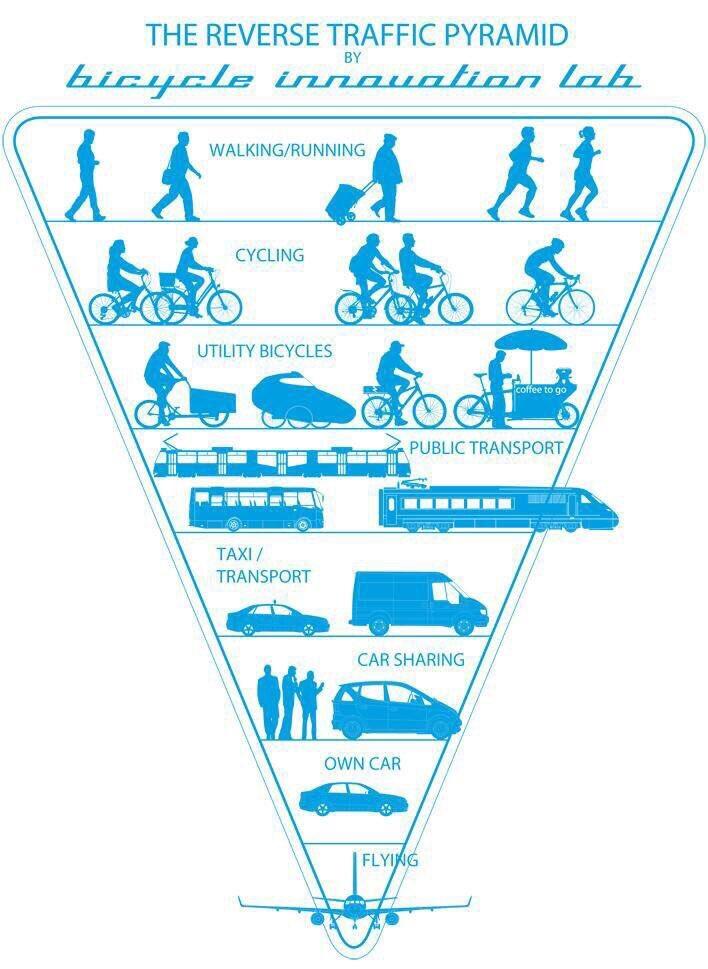
See, the problem with reversing the pyramid, primarily for societies addicted to cars, is that even if all infrastructure was changed to make things the most safe for cyclists and pedestrians, the damage to the mind of the average citizen has to considered as well. The lack of exercise, the lack of the ability to consider one’s individual contribution to environmental pollution and the socioeconomic relationship people have with their private vehicles all have to be dealt as well in order for the outside world to need for such change.
It’s a process, not a problem. Based on analogous estimates, that process takes about 20 years.
Infrastructure isn’t a quick fix either, so the physical and mental domains can progress at the same time.
Nice. I’ve looked into this question fairly deeply and this seems fairly accurate.
Two things that people find counter-intuitive (or in the second case prefer not to think about):
- an intercity bus is usually greener than a high-speed train, even discounting energy source - mainly because speed carries a major efficiency penalty
- air travel is an unmitigated disaster on the level of personal carbon footprints - there’s basically no way to make it sustainable
an intercity bus is usually greener than a high-speed train, even discounting energy source - mainly because speed carries a major efficiency penalty
Are you sure? Where I live all high-speed trains are running on 100% renewable electricity, while intercity buses run on diesel. Also multiple carriages at the same time, traveling on rails, should be significantly more efficient than a single bus traveling on asphalt. I agree that there will be an increase in energy expenditure depending on speed, but it shouldn’t be as significant as the combination of the other two.
air travel is an unmitigated disaster on the level of personal carbon footprints - there’s basically no way to make it sustainable
We would have to make it sustainable eventually, since it’s the only practical way for passengers to travel between americas/australia/afroeurasia. I guess something hydrogen-based is the most likely candidate for reducing the carbon impact.
We would have to make it sustainable eventually, since it’s the only practical way for passengers to travel between americas/australia/afroeurasia. I guess something hydrogen-based is the most likely candidate for reducing the carbon impact.
Hoovering and hydrofoils have been under-explored, but yes, speed is necessary for long-distance travel.
all high-speed trains are running on 100% renewable
Irrelevant to what I said: discounting energy source.
Trains obviously have much less rolling resistance, as you say (an advantage partly offset by their added weight). But wind resistance is the bigger factor, and trains are usually just faster.
A train travelling at 350kmh uses 40% more energy than one going at 300kmh. This is why the service speeds usually top out at 300 everywhere, Europe, japan and China.
Speed really is the decisive factor. The pyramid hints quite well at this.
But we can’t really discount the energy source. An intercity bus service running fully on renewables is not feasible neither now nor for the foreseeable future. What we should do is have more efficient rail service between city, with more slower and cheaper options for when you don’t mind the extra hour on your train.
Defining “green” as energy consumption is quite exotic. More commonly it has to do with resource (carbon and others) footprint.
air travel is an unmitigated disaster on the level of personal carbon footprints - there’s basically no way to make it sustainable
Compared to cars? Or just trains?
Compared to everything.
You’re telling me that 140 people driving from New York to California is more efficient than 140 people taking a single 737?
If they share 35 cars, yes.
If they each drive their own cars, no, it’s close, and depends on what cars they drive.Shared rides is a step above on the pyramid.
From what I can tell it’s not really close. At least for “average cars” and “typical commercial airlines”.
this represents 28 g of fuel per kilometer, or a 3.5 L/100 km (67 mpg‑US) fuel consumption per passenger, on average.
Now take into account that CO2 released at altitude is twice as bad as on the ground, since it absorbs all sunlight before part of it gets filtered out by the atmosphere or reflected by clouds.
I hardly think that’s relevant. CO2 doesn’t stay where it was released.
The concentration of carbon dioxide in the mid-troposphere lags the concentration found at Earth’s surface as mixing from the lower to upper altitudes usually takes days to weeks.
We’re talking about yearly averages and decades of warming. Days to weeks is very short by comparison.
deleted by creator

