Attached: 1 image
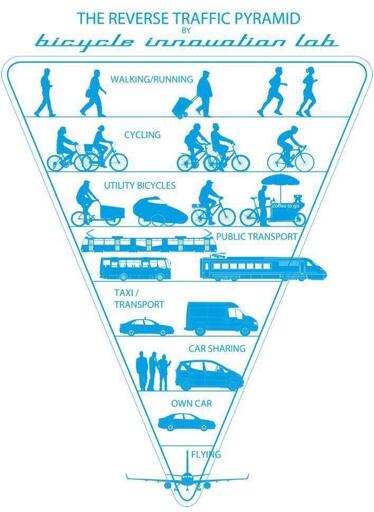
Per ridurre il traffico la piramide delle priorità deve essere rovesciata, così. In più si riducono smog, rumore, pericolo, incidenti e si migliora la salute dei cittadini e la vivibilità della città
https://benzinazero.wordpress.com/2026/02/08/la-piramide-inversa-del-traffico-urbano/ #traffico #mobilità #urbanistica #politica
an intercity bus is usually greener than a high-speed train, even discounting energy source - mainly because speed carries a major efficiency penalty
Are you sure? Where I live all high-speed trains are running on 100% renewable electricity, while intercity buses run on diesel. Also multiple carriages at the same time, traveling on rails, should be significantly more efficient than a single bus traveling on asphalt. I agree that there will be an increase in energy expenditure depending on speed, but it shouldn’t be as significant as the combination of the other two.
air travel is an unmitigated disaster on the level of personal carbon footprints - there’s basically no way to make it sustainable
We would have to make it sustainable eventually, since it’s the only practical way for passengers to travel between americas/australia/afroeurasia. I guess something hydrogen-based is the most likely candidate for reducing the carbon impact.
We would have to make it sustainable eventually, since it’s the only practical way for passengers to travel between americas/australia/afroeurasia. I guess something hydrogen-based is the most likely candidate for reducing the carbon impact.
Hoovering and hydrofoils have been under-explored, but yes, speed is necessary for long-distance travel.
all high-speed trains are running on 100% renewable
Irrelevant to what I said: discounting energy source.
Trains obviously have much less rolling resistance, as you say (an advantage partly offset by their added weight). But wind resistance is the bigger factor, and trains are usually just faster.
A train travelling at 350kmh uses 40% more energy than one going at 300kmh. This is why the service speeds usually top out at 300 everywhere, Europe, japan and China.
Speed really is the decisive factor. The pyramid hints quite well at this.
But we can’t really discount the energy source. An intercity bus service running fully on renewables is not feasible neither now nor for the foreseeable future. What we should do is have more efficient rail service between city, with more slower and cheaper options for when you don’t mind the extra hour on your train.


Are you sure? Where I live all high-speed trains are running on 100% renewable electricity, while intercity buses run on diesel. Also multiple carriages at the same time, traveling on rails, should be significantly more efficient than a single bus traveling on asphalt. I agree that there will be an increase in energy expenditure depending on speed, but it shouldn’t be as significant as the combination of the other two.
We would have to make it sustainable eventually, since it’s the only practical way for passengers to travel between americas/australia/afroeurasia. I guess something hydrogen-based is the most likely candidate for reducing the carbon impact.
Hoovering and hydrofoils have been under-explored, but yes, speed is necessary for long-distance travel.
Irrelevant to what I said: discounting energy source.
Trains obviously have much less rolling resistance, as you say (an advantage partly offset by their added weight). But wind resistance is the bigger factor, and trains are usually just faster.
A train travelling at 350kmh uses 40% more energy than one going at 300kmh. This is why the service speeds usually top out at 300 everywhere, Europe, japan and China.
Speed really is the decisive factor. The pyramid hints quite well at this.
But we can’t really discount the energy source. An intercity bus service running fully on renewables is not feasible neither now nor for the foreseeable future. What we should do is have more efficient rail service between city, with more slower and cheaper options for when you don’t mind the extra hour on your train.
Defining “green” as energy consumption is quite exotic. More commonly it has to do with resource (carbon and others) footprint.