
cross-posted from: https://scribe.disroot.org/post/10699784
[Original in Russian. Automated translation with minimal edits]
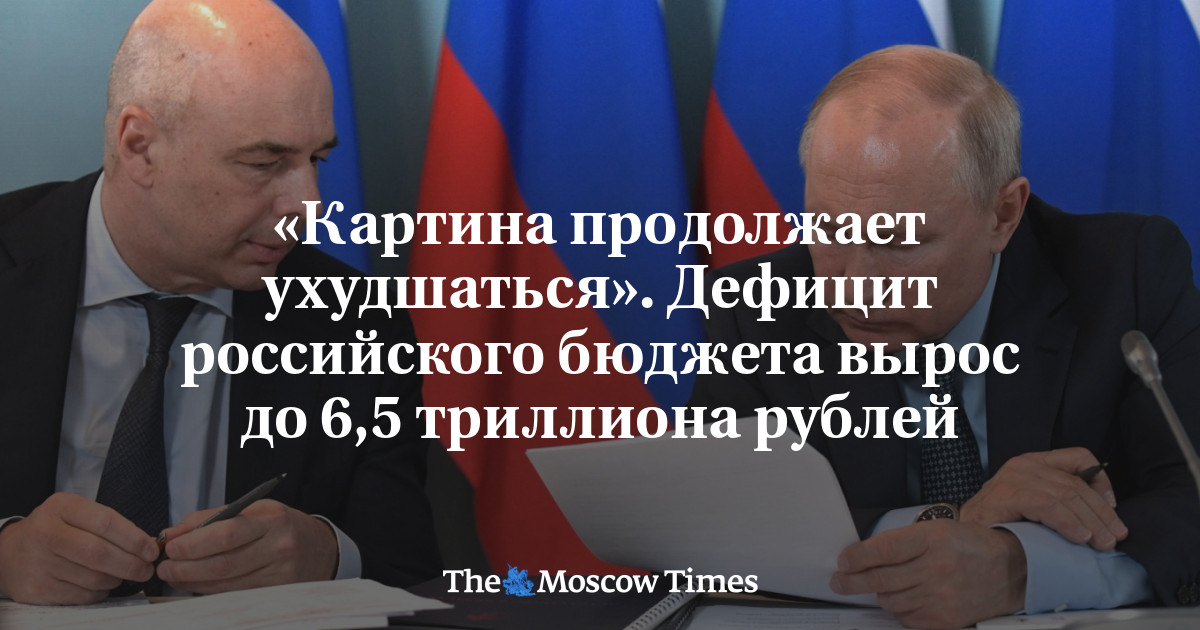
Russia’s federal budget deficit increased again in July, the Finance Ministry reported on Tuesday.
Over 7 months, the government collected 22.112 trillion roubles in taxes for the treasury — 8.8% more than the previous year. At the same time, expenditures increased almost twice as fast as revenues — by 14.5%, to 28.567 trillion roubles.
As a result, at the beginning of August, a “hole” of 6.455 trillion roubles appeared in the budget — an amount equal to the annual budget of Moscow, four annual budgets of St. Petersburg and 11 annual budgets of large regions such as Tatarstan or the Krasnodar Territory. Compared to the same dates last year, the deficit has increased by 1.4 times and is already almost twice the plan for the whole year (3.786 trillion roubles).
The fundamental picture for the budget continues to deteriorate, states Finam strategist Yaroslav Kabakov: oil and gas revenues for the first seven months decreased by 16.8%, and the increase in revenues from higher VAT (by 24.9%) barely compensates for this shortfall. At the same time, the Ministry of Finance is spending more and more, and it seems that by the end of the year, expenses may exceed the plan by almost 5 trillion roubles, according to Kabakov’s assessment.
Balancing the budget is becoming increasingly difficult, notes Ilya Sokolov, a leading researcher at the Gaidar Institute: the surge in oil and gas revenues due to the war in Iran turned out to be short-lived and was largely spent on subsidies to oil companies, whose refineries are burning and shutting down one after another.
Non-resource revenues are increasing only due to higher taxes, not economic growth, Sokolov emphasises: in the first half of the year, GDP grew by only 0.3%, and in the second half of the year, the economy may slide into recession. This will lead to a shortfall of 600-800 billion roubles in VAT, as well as in corporate and personal income tax, warns Sokolov. By the end of the year, the budget deficit could approach 10 trillion roubles, Khabakov predicts.
Military spending remains the main unknown for the budget: it is clear that it will exceed the plan, but it is not yet known by how much, notes Ekaterina Vlasova, an economist for Russia and the CIS at Bloomberg Economics. According to Bloomberg, the Ministry of Defence is demanding an increase in the military budget by 40%, or 4-5 trillion roubles. The Ministry of Finance planned to satisfy the military’s appetite through debt, but in July it was forced to suspend government bond auctions due to the market collapse.
Most likely, after the State Duma elections, fiscal tightening should be back on the agenda, Vlasova warns: the authorities may cut spending on non-military items or raise taxes. Due to problems with raising debt, a new VAT increase is possible, according to economist Kirill Rodionov.
Since the beginning of the invasion of Ukraine, the budget has spent almost 50 trillion roubles on the war. To pay for the army and weapons production, the government spent three-quarters of the National Welfare Fund’s available funds, introduced export and exchange duties, increased the mineral extraction tax, and confiscated private assets worth 4 trillion roubles. In 2025, income tax and personal income tax for wealthy citizens were increased, and in 2026, VAT and taxes for small businesses rose.
“The easy money for the Kremlin is over,” says Agathe Demarais, a senior fellow at the European Council on Foreign Relations: having started with businesses and billionaires, the authorities have switched to the wallets of ordinary people. This does not mean that Vladimir Putin “will soon run out of money, but he is definitely running out of politically acceptable ways to find it,” Demaraïs emphasises.
…
That’s about $78.85 billion. Something will have to give, soon.
Why? Other countries are in so much debt they can never repay it.
so much debt they can never repay it.
I think there’s a slight misconception here (that is quite common). Let’s say you have an income of 100 Kronk, and a debt of 1000 Kronk. Further, let’s say that every year, your income is expected to increase by 5 %, and you spend 5 % of your income to pay down your debt. This year, you pay down 5 Kronk, next year you pay down 5.025 Kronk, etc. That means you can take out a loan of 5 Kronk this year, 5.025 Kronk next year, etc. in order to maintain a perpetual debt of 1000 Kronk, and a perpetual income after down-payments of 100 Kronk. (Adjust the numbers a tad to account for interest)
The point is: Even though you have perpetual debt, every debtor is being repaid on time. You’re basically just refreshing the debt. As long as people trust that you will be able to pay them back with interest, they have no issue giving you more loans - after all, they’re making bank off this.
This is overly simplified, but the idea is basically that as long as your income is increasing as fast or faster than your debt over time, debtors can trust that they’ll get their money back with interest, and you’ll be able to take out loans. This is basically why the US is able to keep taking up more loans, and have an ever-increasing national debt. Whether that trust is justified, and whether this is really a good, sustainable idea is a whole different question.
The issue russia is seeing now is that people don’t trust that they’ll be paid back with interest, at least not in a currency they care about. Basically, their income is stagnating (maybe even declining soon), while their debt has exploded. It’s more about the rate of change and prognosis for future development than the actual income/debt ratio today. When nobody wants to give them new loans, they can no longer “refresh” their old loans: Previously, they could just take out a new loan to pay down one that was close to defaulting if they were in a tight spot, they can’t do that when nobody wants to give them new loans. That means they need to spend even more of their income to pay down loans to keep them from defaulting (which would make the situation even worse for them).
So long story short, they’re pretty much spiralling at this point.
Other countries are actually able to take out debt. Meanwhile, Russia has canceled several of their bond auctions recently because nobody wants to buy Russian bonds, even at the wild 15%+ interest rates.
Additionally, it doesn’t take very many bonds at interest rates like that to drain all available state cashflow. For comparison, US bonds are going for 4%.
Outrageous debt is the new chic thing for Cool Dictatorshits
Uh-oh, someone is in truble!