

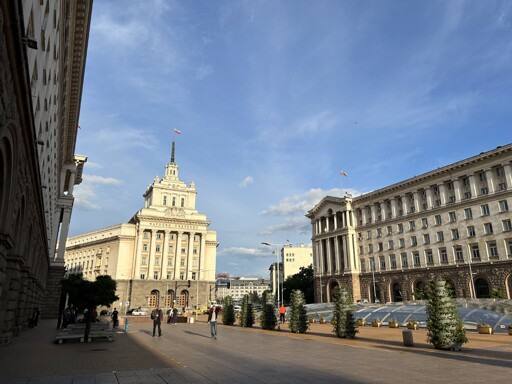
Bulgaria’s story is not one of failure. It is one of asymmetry. The country has achieved many of the objectives of post-communist integration, while some of the domestic reforms meant to accompany that process remain incomplete. Bulgaria has become more European in legal and institutional terms, but not always more predictable, transparent or accountable in daily life.
Another expression captures the same phenomenon even more directly: “imam chovek”, which literally means “I have someone.” Popularized by the rapper and politician Itzo Hazarta (real name Hristo Petrov), the phrase refers to the informal networks that often mediate access to opportunities, services and influence. Need a document processed quickly? A recommendation? A favour? “I have someone.” It is a joke, but one rooted in a social reality many Bulgarians immediately recognize.
This historical gratitude does not necessarily translate into support for the Kremlin. Yet it helps explain why debates about Russia remain emotionally and politically more complex than elsewhere on NATO’s Eastern Flank. Bulgaria’s relationship with Russia is shaped not only by current security concerns, but also by historical memory.
None of this should obscure the country’s achievements. Bulgaria is wealthier, more open and more secure than it was before joining the European Union. Its cities are changing. Its cultural influence is growing. Its civil society remains active. The country’s democratic story is unfinished, but it is not hopeless.
For the European Union, Bulgaria offers an important lesson. Integration can anchor countries geopolitically, but it cannot by itself create trust. Membership, funding and formal compliance matter, but they do not automatically generate institutions that citizens believe in.
You must log in or # to comment.
“Imam chovek” is “I know someone” in Canada. Western meritocracy and equality before the law and institutions are a myth, perhaps better masked and maybe to a lesser extent than in Bulgaria but a myth nonetheless. Want a nice job? Wonder why no one calls you for an interview? Gotta know someone “to put your resume at the top of the pile.” “Building a network” is a standard openly stated part of the purpose of higher education here.
I’ve been reflecting a lot on this, as well as other forms of equality, given that our context is born in Bulgaria, which is trying to transition, and living in the West which is supposedly more advanced in this matter.
One of the conclusions I believe to have reached is that myths matter. When people are born and grow up with the expectation of equality and fairness, they object when they see it violated. Otherwise, they just accept it as it is. I believe this is a source of an important generational gap.
But imam chovek is also a problem to be solved. If things don’t happen without connections (i.e. personal motivation on behalf of the person delivering the service), one seeks other ways to achieve them. And this is an important source of innovation. In a better society, one would seek to solve the problem not only for themselves, but also for others to come. In capitalism, this solution arrives with a commercial benefit. Not the only possible way, but commonly quite an effective way.
I’m society with big immigrant communities, personal connections are more segregated and these type of problems stand stronger, so the drive to find solutions is stronger.
I’m saying all this not as something to convince you, but as something for which I seek validation from you. :)