

- cross-posted to:
- linguistics@mander.xyz
It’s a bit of pop linguistics about the dual number in English, with a few inaccuracies, but it’s interesting regardless. I’ll provide here some further historical info.
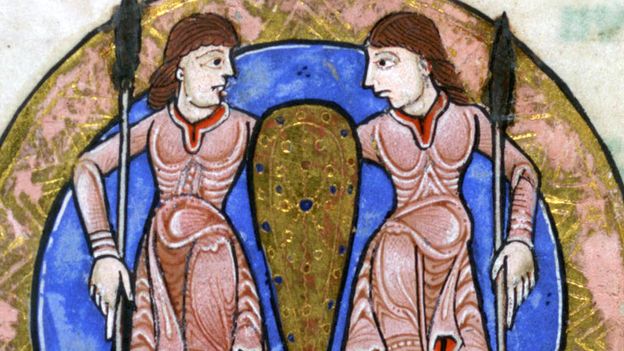
Proto-Indo-European contrasted three grammatical numbers: singular, dual, and plural. With the dual being used mostly for things that come in pairs (like arms or a couple). By Proto-Germanic times, the dual only survived in the pronouns, as you can see in this table:
| Person/number | Nominative | Accusative | Oblique | Possessive |
|---|---|---|---|---|
| 1SG (“I”) | ek~ik | mek~mik | miz | mīnaz |
| 1DU (“we both”) | wet~wit | unk | unkiz | unkeraz |
| 1PL (“we”) | wīz~wiz | uns | unsiz | unseraz |
| 2SG (“thou”) | θū | θek~θik | θiz | θīnaz |
| 2DU (“you two”) | jut~jit | inkw | inkwiz | inkweraz |
| 2PL (“y’all”) | jūz~jīz | izwiz | izwiz | izweraz |
| reflexive (“self”) | se- | sek~sik | siz | sīnaz |
Note those forms are reconstructed (I didn’t want to clutter the table with asterisks). That ⟨θ⟩ is to be read as in “think”, ⟨j⟩ as in “yes”, and the vowels as in Spanish or Polish, with a mācron making them lōnger (longcat is looooong lōng).
The dual pronouns would survive until Early Middle English (up to 1350), but were increasingly less used. I believe most of the other pronouns from that table survived.
Can you imagine how cute it must have been to have a couple’s pronoun? You’re a ninth century peasant boy at the may pole festival and your crush is like “come on” and you’re like “where are we (3+) going?” and they’re like “we (two) are going exploring deeper into the woods” and all of a sudden you feel all the blood rush to your face and you’re blushing like a maniac because they’re using the couple pronouns. Bring them back!
English is almost regenerating the singular/plural distinction for 2nd person pronouns, given how common expressions like “you guys”, “you all” etc. are. And they’re often shortened into a single word; e.g. “yall”. Theoretically nothing prevents it from happening with “we both”, “you both” and “they both”, provided there’s enough semantic pressure to do so. Basically you’d need people treating sets of two elements as something intrinsically different from many.
(A shame that, if this ever happens, the “bo” in “both” might get eroded into nothing. Even if it’s one of the few leftovers of that dual.)
You think it’d displace the existing youth? Or just be homophonous?
[Note this is all just conjecture, not solid info.]
Under the hypothesis there was some pressure to remake the dual pronouns, I think neither would happen. It would take some time for “you both” to collapse into a single word, and get rid of the “bo”; by then “youth” would be also evolving.
Plus I think the [əʊ]~[oʊ] would interact with the preceding vowel, before being gone; English has a tendency to open diphthongs so it’ll likely end as [äʊ] or [ɑʊ] later on, so the [u]~[ə] (dialect-dependent) from the “you” might get lowered. You might end with something like [ʒɑf]; in contrast “youth” would end as [ʒuf], I think. (I’m predicting [j]→[ʒ] as it’s a really common sound change, and [θ]→[f] aka TH-fronting is spreading in English.)
My only regret is that I have but one upvote to give. It’s a plausible prediction!