deleted by creator
Vocal exercises will be key since it’s a tonal language. When you practice, try hard to match every aspect of the examples. Like full blown try to sound exactly like the person speaking. You likely won’t match their vocal quality exactly but it will certainly help you get the pitch changes.
As with any language, you should try forcing yourself to write/speak in Mandarin. (Writing Chinese characters can suck though so typing or writing out the pinyin is probably a better if you’re just starting out.) The best way to learn to speak a language is going to be trying to translate your thoughts into that language. You might be able to parse mandarin well if you only listen to or read it, but speaking requires more thought and helps you build vocabulary better.
As you get more used to the language, watching shows or reading books in the language will become easier and should allow you to learn the meanings of words through context clues—like children do—rather than relying on translation/dictionaries directly.
好运!
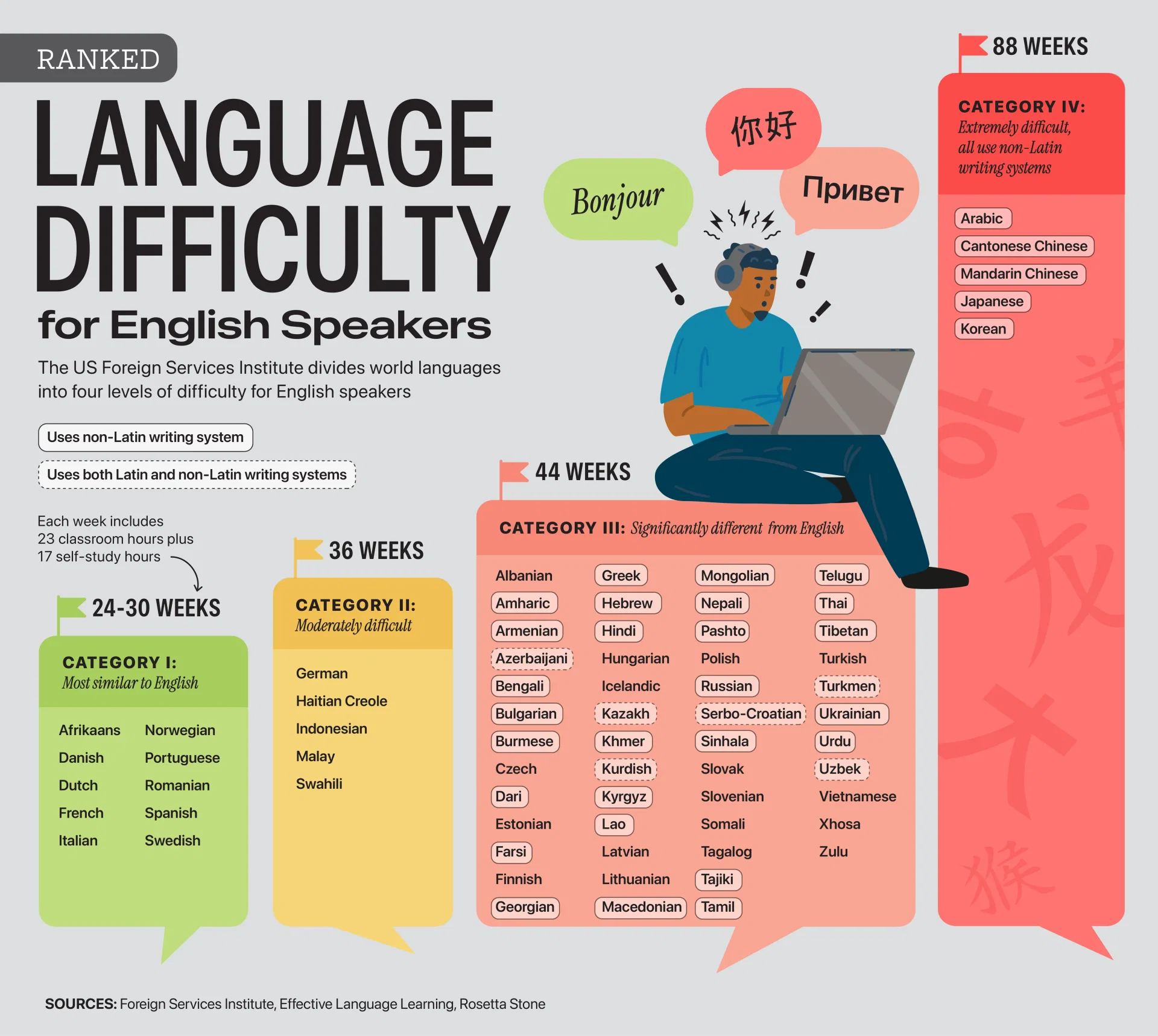
I’m not sure why they have Haitian Creole as more difficult than French. The vocab is extremely similar to French and the grammar is easier. So I’m wondering what aspect of it they think is more difficult than the languages in Category 1.
deleted by creator
Thanks for those examples! I guess I was just thinking of things like verb tenses using markers instead of conjugations.
deleted by creator
Well, I didn’t think that alone automatically made it easier, though I do think that no conjugation plus the amount of familiarity in the vocabulary are major factors, not to mention using the same alphabet. So from the admittedly short amount of time I spent on Haitian it felt like a similar difficulty to French, but then I probably didn’t get beyond the basics enough to be exposed to the higher difficulty level of syntax you talked about.
But yes, syntax is huge. I spent years on Mandarin, even with a willing native speaker friend to help out, but finally accepted that it was beyond my capabilities (being already in my 40’s at the time didn’t help either). And it wasn’t even the tones so much; the measure words/classifiers you mentioned weren’t much problem either. It was indeed the syntax (except for simple straightforward sentences). Often I could recognize every character in a sentence and know its individual meaning, but still be at a loss to understand the overall meaning of the sentence. And with verbs, Haitian clearly marks exactly which tense/aspect is meant, in a system that an English speaker can understand intuitively. Mandarin not so much!
There’s a good chance I’m not qualified to proclaim this opinion out loud, but this is the internet so…
I don’t think Indonesian belongs in the yellow category. Indonesian has no tenses, no cases, nothing. Sure, there’s little-to-no overlap in the vocab, but the structure of the language was so straightforward, that a month or 2 with the phrasebook was basically all that was required to survive in country. I wasn’t having a lot of deep conversations in Indonesian, but one time I excused myself while squeezing past somebody on a plane, mistakenly giving him the impression that I was local, and ended up getting invited to his sister’s house for dinner during Eid.
For context, I took 2 years of French in High School (where I took it more seriously than you’d think), and I took 3 courses of Russian in undergrad.
Why would Arabic be more difficult to learn than Hebrew or Russian or Polish? They mean reading and writing it, not speaking? Even so it doesn’t seem worse than Russian or Hebrew.