
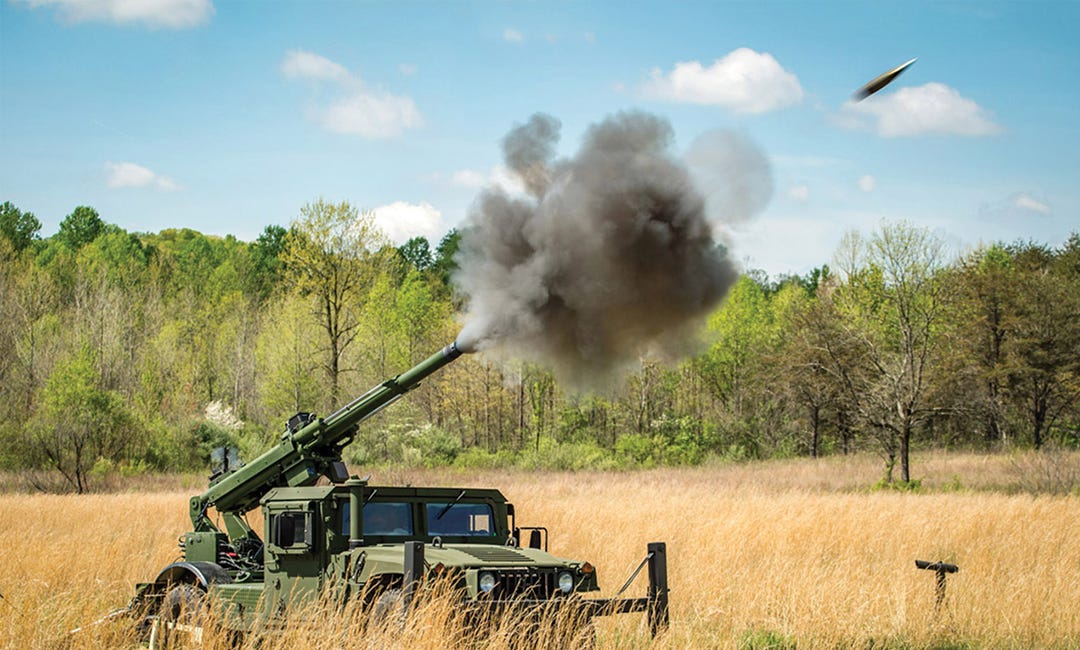
Well I noticed, but I am a weirdo.
This technology while obscure represents one of the most fundamental advances in cannon artillery in decades and it is already being fielded. India has developed a similar technology/licenses the same technology for high altitude highly maneuverable 4x4 mounted 105mm howitzers.
The frustrating reality of covering experimental systems in Ukraine is that Ukraine doesn’t publish Google reviews of prototype artillery.
As of May 29, 2026, there are no major public battlefield reports declaring the Hawkeye either a war-winning breakthrough or a categorical failure. No public after-action reviews. No official Ukrainian statements rating the system against the Caesar or the M777. Operational silence.
That silence is probably a good sign.
Ukraine has a well-documented and unsentimental relationship with equipment that doesn’t perform.
Systems that fail in combat at the tactical level become known. Social media footage surfaces. Milbloggers talk. Ukrainian units share feedback through channels that eventually reach open-source analysts.
If the Hawkeye had been failing catastrophically, three deployments of drone footage and an angry Telegram thread would have surfaced by now.
What we do know: AM General described the system as “combat proven” at AUSA 2024. Ukraine apparently continued using it after initial evaluation. And AM General unveiled a next-generation version at AUSA 2025, upgraded and built around the standard M119 105mm gun, directly citing the Ukraine experience as part of the development process.
Companies don’t build second generations of systems that embarrassed them in their first combat trial.
edit 1 I should have noted that Kosovo has been the first country to officially order the Hawkeye 105mm systems.
edit 2 It is also worth noting India has been producing a very similar vehicle known as the Garuda 105mm referred to as the “Go Anywhere Garuda” perhaps through the same companies or shared contracts I don’t know? The Garuda was made for the Himalayas and getting artillery into otherwise unreachable places.
https://idrw.org/brazil-expresses-interest-in-kalyanis-garuda-105_v2-4x4-go-anywhere-gun/
The product page:
https://www.amgeneral.com/what-we-do/vehicles-chassis/humvee-2ct-hawkeye-mhs/
There’s a video of a crew shooting the gun. They stop the truck, set up, shoot 10 times, and start to drive off in a little under 4 minutes. There’s a support truck that carries the ammo.
Yeah, those are ridiculous stats for something that isn’t a 30 million dollar dizzingly complex self-propelled howitzer with a billion little parts.
The innovation of a soft artillery implementation like this is kind of lost on most coverage and by most analysts as they look at something like the RCH-155, PZH2000, Archer or other complex large artillery pieces and consider something like the Hawkevey 105mm inferior… but that is comparing apples to oranges.
Think about weight and cost, the hawkeye artillery system isn’t attempting to compete with an RCH155 or PZ2000. It is a mass producable, lightweight 105mm piece slapped onto a chasis that is extremely common and near maximally offroad capable for a 4x4 wheeled vehicle.
A big part of surviving as artillery is about being able to be potentially anywhere so it isn’t easy to narrow down where you actually are. This is one of the reason mortars have always been so decisive, they can go almost anywhere.
The thing with a soft recoil artillery system is the weight savings you get allow you to bring a full on 105mm artillery system to bear in situations that normally you would at best be hoping for mortar support. This system represents just as much an evolution of the “technical” archetype of a light essentially unarmored 4x4 squad vehicle mounting a big hit and run gun as it does a traditional artillery system. It is both.
There is a lot of interest in 120mm mortars bolted to the back of squad vehicles, but implementing a soft recoil full power 105mm cannon just puts you into a completely different ball game of force application both in direct fire and indirect fire than mortars ever can.
There is a lot of interest in 120mm mortars bolted to the back of squad vehicles
Doing that the classic way tends to make those mortar vehicles, with zero dismounts, like the mortar variant of the cv90.
This is SO much better, except that you need a spare vehicle for the ammo. Oh well, not a big cost in pretty sure you can get a few dozen humvees for the price of one cv90
You noticed and we love you for that.
I’m not familiar with all those different weapons systems. What sort of range and accuracy do these 105 mm soft recoil systems typically have and how does it compare to the other mobile systems mentioned?
From the article
It can hit a target 11.6 kilometers away with standard ammunition, or nearly 20 kilometers with extended-range rounds.
Accuracy not specified
105mm artillery doesn’t win the range battle against 122mm artillery and in many cases an 120mm mortar will be able to do similar damage but this is an area where just looking at the numbers on paper begins to become misleading.
The 105mm is about volume of fire, speed of fire, and lightweightness in a package that can be deployed into situations heavier alternatives take longer to do so with, and that kind of advantage is one of the most crucial in war.
The 105mm typically has a maximum range around of up to 20km with a 120mm mortar having half that range.
Aha, so it’s mainly for suppression and therefore doesn’t need super high accuracy?
No, if it is anything like other western 105mm howitizers it is very accurate.