

- cross-posted to:
- linguistics@mander.xyz
It’s a bit of pop linguistics about the dual number in English, with a few inaccuracies, but it’s interesting regardless. I’ll provide here some further historical info.
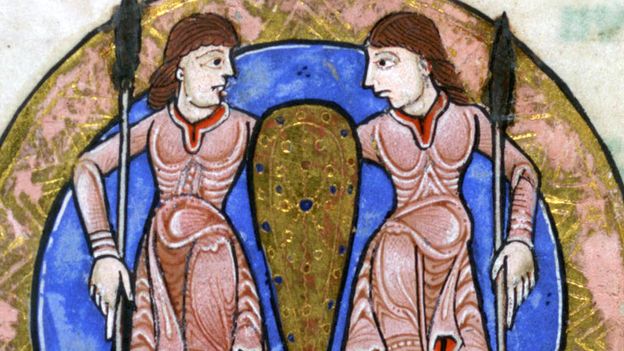
Proto-Indo-European contrasted three grammatical numbers: singular, dual, and plural. With the dual being used mostly for things that come in pairs (like arms or a couple). By Proto-Germanic times, the dual only survived in the pronouns, as you can see in this table:
| Person/number | Nominative | Accusative | Oblique | Possessive |
|---|---|---|---|---|
| 1SG (“I”) | ek~ik | mek~mik | miz | mīnaz |
| 1DU (“we both”) | wet~wit | unk | unkiz | unkeraz |
| 1PL (“we”) | wīz~wiz | uns | unsiz | unseraz |
| 2SG (“thou”) | θū | θek~θik | θiz | θīnaz |
| 2DU (“you two”) | jut~jit | inkw | inkwiz | inkweraz |
| 2PL (“y’all”) | jūz~jīz | izwiz | izwiz | izweraz |
| reflexive (“self”) | se- | sek~sik | siz | sīnaz |
Note those forms are reconstructed (I didn’t want to clutter the table with asterisks). That ⟨θ⟩ is to be read as in “think”, ⟨j⟩ as in “yes”, and the vowels as in Spanish or Polish, with a mācron making them lōnger (longcat is looooong lōng).
The dual pronouns would survive until Early Middle English (up to 1350), but were increasingly less used. I believe most of the other pronouns from that table survived.
At least now I know how Linus came up with “git blame”!
Interpreting it as “you both blame” is fun.