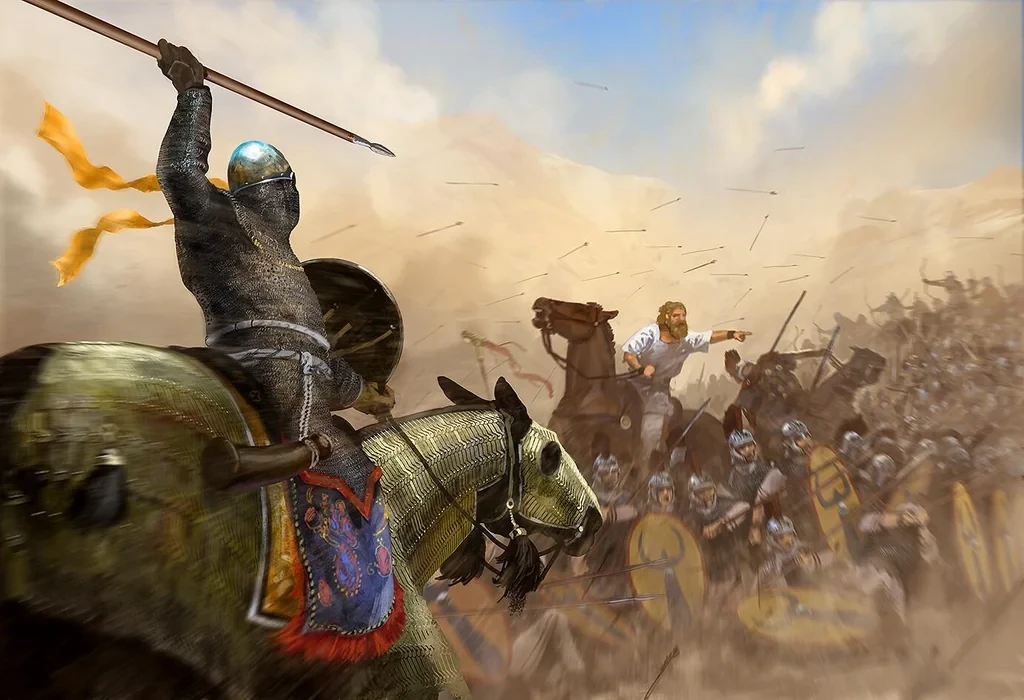
Hell of a piece. That horse & rider really do 85% of the heavy lifting, it seems to me.
I suspect that more use of perspective would really enhance curiosity about history photos like this.
Yeah, Julian caught a javelin during the attack, which probably wouldn’t have killed him… except that he had rushed to show his troops that THEIR EMPEROR WAS WITH THEM during the ambush, and so neglected to put on his goddamn armor. Lingered in agony for a few days and then died. Big RIP, you were a real one Julian
When I was ~10yo, for some reason I became obsessed by the American Civil War. I seem to recall learning about a rather high number of military leaders who became so distracted upon leadership that they became relatively easy marks for enemy riflemen, and lost limbs or their lives as a result. They neglected their Emperor Julian training, I guess. :S
The Civil War was crazy for that. The casualty rate of the brass was insane. Some of it was because a lot of them were really just civilians, some of it was because the ‘norm’ of rifled weaponry hadn’t really set in the thinking of militaries then (even though it’s a MASSIVE game changer), and some of it is that 19th century MANLY bravado. Dulce et decorum est…
General Sherman, for example, who was as bright - and honestly as paranoid - as a general as one could hope for, I remember in one small meaningless skirmish observing the line, standing up, in full view of the enemy, while bullets were whizzing around him and one of his own men (who was taking cover) asked him to get down for his own safety.
Sherman told him, “Mind your own goddamn business” and went back to observing the skirmish.
To be fair, Sherman was very much a ‘soldier’s soldier’, he knew how his troops thought and how they’d react. The soldier who relayed the story in his journey essentially writes after that, “Well, I guess if the General is calm under fire, he must have things under control.” And that unshakability is a great advantage… it’s just… if you do get domed by bullet, the disadvantage for your side is much greater than the advantage received.
I guess I’d forgotten that about Sherman, but I certainly remember stories like that in general. Indeed, it was really quite amusing, coming across glowing historical accounts that described such behavior as ‘terribly brave and even noble, standing up in a hail of bullets.’
I guess I hadn’t quite realised that rifling only became common in the mid-1800’s, even though it was technically invented much earlier. Another thing I seem to remember about the ACW is that military leaders commonly employed tactics & strategy that was more-suited to earlier eras, contributing to the high loss of life.
Another thing I seem to remember about the ACW is that military leaders commonly employed tactics & strategy that was more-suited to earlier eras, contributing to the high loss of life.
Oh yeah. In a big way. They were treating the war like it was Napoleonic, and it was fucking industrial. Small arms had quadruple the range and significantly greater precision and accuracy at smaller distances and fired faster, artillery was MUCH more deadly, and the resources able to be marshalled by each side via trains and canals were so massive that the war couldn’t be decided by a few battles, but instead by brutal attrition.
Ah, “Napoleonic.” Perfect…
the resources… were so massive that the war couldn’t be decided by a few battles, but instead by brutal attrition.
Huh, that’s interesting. But, I mean… what if the North had had top-level, quality leadership, as comparable to Robert E. Lee on the other side? Under such soicumstances (sorry, Curly Howard moment), couldn’t the war have been ended earlier, and more efficiently?
Btw, I remember now taking a stab at the ACW over at my community. Sadly, some pics dropped out, but there’re still plenty left. I even think you reviewed it for me! Altho… I would have to pretty much rewrite the article to incorporate what you recommended at the time. (good problems to have, eh?)
Huh, that’s interesting. But, I mean… what if the North had had top-level, quality leadership, as comparable to Robert E. Lee on the other side? Under such soicumstances (sorry, Curly Howard moment), couldn’t the war have been ended earlier, and more efficiently?
Lee is overrated, and lacked strategic vision. But it is possible that there could have been a quick ‘knockout’ blow in maybe the first year of the war, especially if First Bull Run went differently. It would be snuffing the fire before it reaches the trail of gasoline.
After that, though, both sides had retooled for a total war that neither of them truly understood. Sherman and Grant, interestingly, both did understand this strategic outlook from the start.