
You must log in or # to comment.
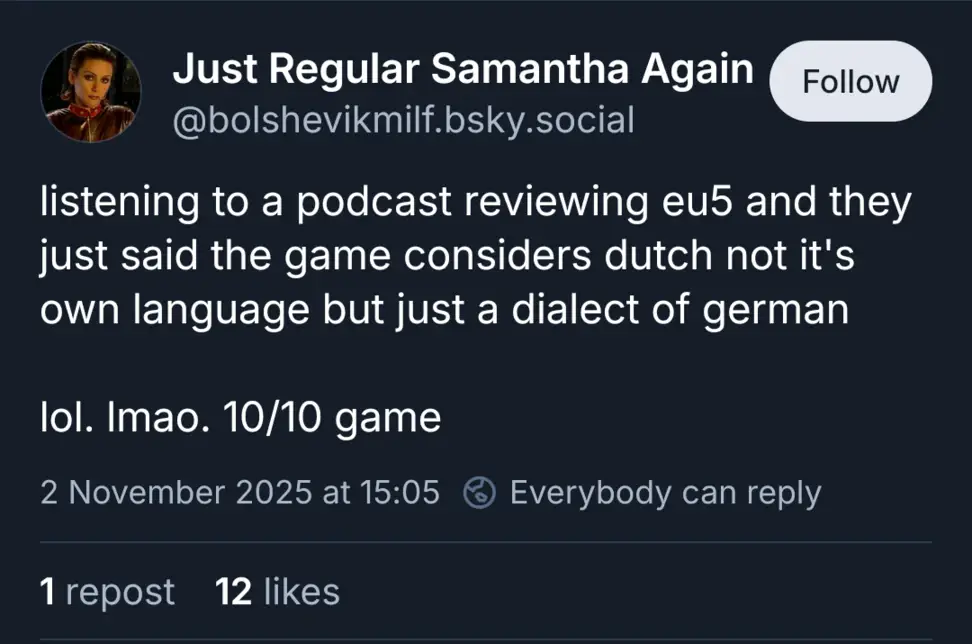
When is EU5 set? It’s not really wrong in like the 13th century (to the extent that “German” exists at all, rather than being a collection of related languages with wildly varying mutual intelligibility).
It starts in 1337 and goes through until 1837. It probably is accurate to the time, but still I find it funny conceptually.
Nah, unless OOP meant Germanic instead of German, it’s not really accurate. Any grouping of Germanic languages is arbitrary to an extent, but this is particularly poor. Dutch shared a lot of similarities with Low German (dialects spoken in the north of what is now Germany), but High German was very distinct from Low German. Grouping Low and High German together as “German” doesn’t make sense in this time period, let alone adding Dutch into the mix.
Dutch is in a category called “German” that also includes Low German, Middle German, High German, Alemannic, and Yiddish. The next level up includes stuff like English, Frisian, Swedish, and the other Germanic languages. For comparison, the “Spanish” category that’s on the same level as “German” includes Aragonese, Castilian, Ladino, and Leonese (but not Catalan, that’s in a separate category)
Grouping English and Frisian with Swedish is ridiculous. It’s like they didn’t even bother giving Wikipedia a cursory glance.
They’re not grouped like that. Sorry if I explained poorly. The game has categories of languages and then sub-categories within those. Germanic is a top-level category. It includes the sub-categories German, Frisian, English, and Scandinavian. Dutch, Low German, and the others in that first list go in the German sub-category. Frisian is in the Frisian sub-category, English is in English, and Swedish is in Scandinavian
Ah okay, that makes much more sense!
Early Dutch was actually a Middle German dialect that had some elements of Low German, there was basically no difference between the dialect that was/is spoken in the German town of Kleve and the Dutch across the border, and the Kleve dialect was/is just another in a gradient of similar dialects in the area. And yes, High German is distinct from Low German, but Low German is not less German than High German; if anything, today’s Standard German is mostly based on Middle German dialects such as Obersächsisch (Upper Saxon, unrelated to the (proto-)Low German-speaking Saxons), with some pronounciation elements from both Low German and High German.
Calling Standard German “Hochdeutsch”, though common in colloquial German, is a misnomer and doesn’t really correspond to the linguistic categories of Low, Middle and High German.
I’m not suggesting that Low German is any less German than High German. I just don’t think grouping them together makes sense linguistically.
I think it starts in the 14th century and goes up to the 19th