Early Dutch was actually a Middle German dialect that had some elements of Low German, there was basically no difference between the dialect that was/is spoken in the German town of Kleve and the Dutch across the border, and the Kleve dialect was/is just another in a gradient of similar dialects in the area. And yes, High German is distinct from Low German, but Low German is not less German than High German; if anything, today’s Standard German is mostly based on Middle German dialects such as Obersächsisch (Upper Saxon, unrelated to the (proto-)Low German-speaking Saxons), with some pronounciation elements from both Low German and High German.
Calling Standard German “Hochdeutsch”, though common in colloquial German, is a misnomer and doesn’t really correspond to the linguistic categories of Low, Middle and High German.


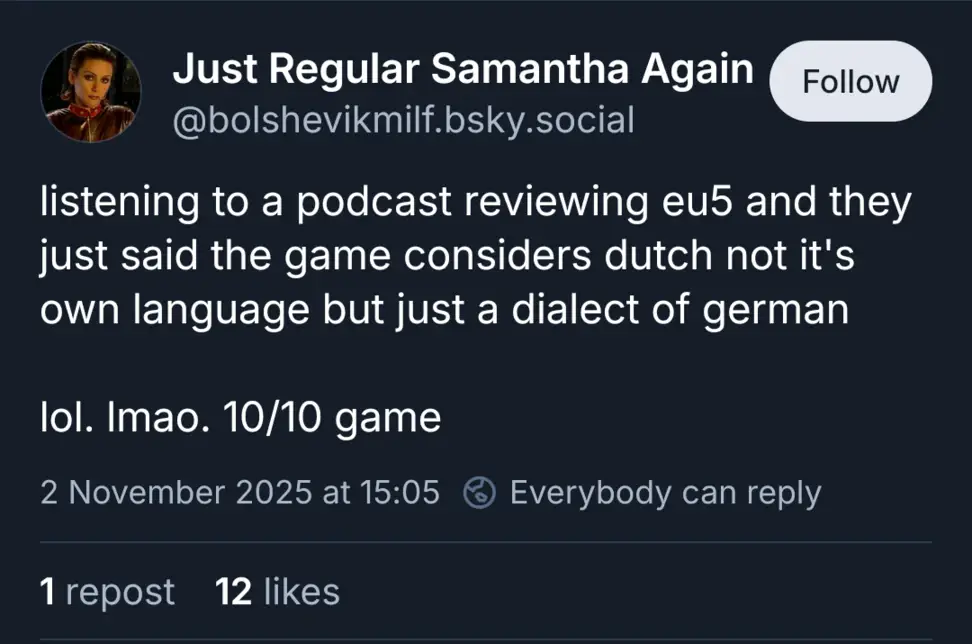
Early Dutch was actually a Middle German dialect that had some elements of Low German, there was basically no difference between the dialect that was/is spoken in the German town of Kleve and the Dutch across the border, and the Kleve dialect was/is just another in a gradient of similar dialects in the area. And yes, High German is distinct from Low German, but Low German is not less German than High German; if anything, today’s Standard German is mostly based on Middle German dialects such as Obersächsisch (Upper Saxon, unrelated to the (proto-)Low German-speaking Saxons), with some pronounciation elements from both Low German and High German.
Calling Standard German “Hochdeutsch”, though common in colloquial German, is a misnomer and doesn’t really correspond to the linguistic categories of Low, Middle and High German.
I’m not suggesting that Low German is any less German than High German. I just don’t think grouping them together makes sense linguistically.