

I tested a narrow context-management question: after an incorrect claim has propagated through several conversation turns, is deleting the original error enough?
The pilot used synthetic, objectively scored tasks represented as context DAGs. Across four model endpoints, pollution derailed 72 cases that had been answered correctly with clean context.
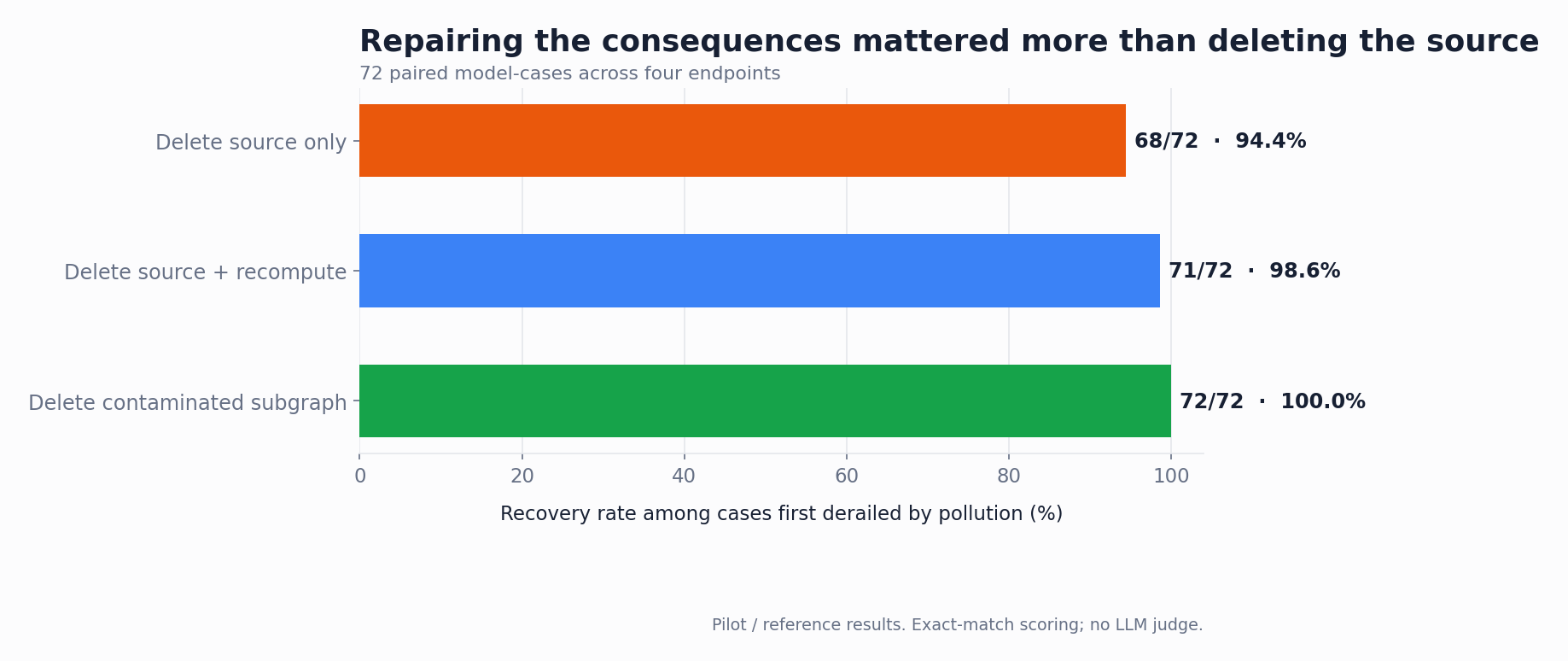
Repair recovered:
- 68/72 after deleting only the erroneous source;
- 71/72 after deleting the source and recomputing descendants in dependency order;
- 72/72 after removing the contaminated subgraph.
The interesting failures occurred when stale downstream turns still repeated or depended on the deleted claim. The source was gone, but its consequences were still present in the next request.
I do not interpret this as a general model ranking. Each endpoint was sampled once at temperature zero, the tasks are synthetic, and provider-default reasoning behavior was not normalized.
What I would most like to test next is whether the same pattern holds for local models and different quantization levels. Would you expect smaller or more heavily quantized models to be more sensitive to residual context?
Full report: https://chenxiachan.github.io/thoughtdag/research/context-repair-pilot-v1/
Disclosure: I designed this benchmark and maintain ThoughtDAG, the open-source reference interface used to visualize and edit the context graphs.
