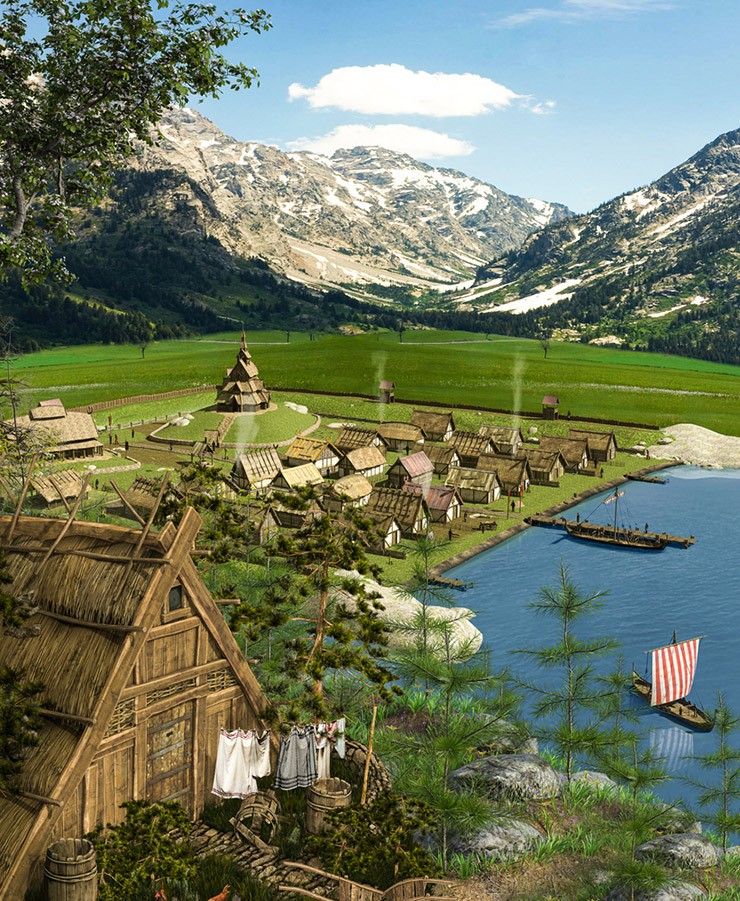
Ehh, kinda but no… I have a lot of issues with this, but for imaginations sake this would be exclusively Norwegian landscape and building resource wise. The farther north you go, wood gets more precious so more stone and turf are used. The more I look at it the more I am irked lmao.
Here’s some examples of settlements from the Viking Age.
Overview:
- https://hurstwic.org/history/articles/daily_living/text/Towns.htm
- https://www.thedockyards.com/architecture-viking-age-urban-planning-emporia-strongholds/
Denmark (Jelling): Jelling is an old and important historical town in the history of Denmark. In the Viking Age it served as the royal seat of the first Monarchs of the Kingdom of Denmark, including Gorm the Old, Þyra and Harald Bluetooth. Jelling is the site of a large stone ship and two large burial mounds, the Jelling stones, and Jelling Church.
- https://en.natmus.dk/historical-knowledge/denmark/prehistoric-period-until-1050-ad/the-viking-age/the-monuments-at-jelling/
- https://kongernesjelling.dk/en/page/about-us/unesco
- https://en.wikipedia.org/wiki/Jelling
- https://commons.wikimedia.org/wiki/Jelling_Mounds,_Runic_Stones_and_Church
- Other mostly Unique to DK settlements: https://en.wikipedia.org/wiki/Viking_ring_fortress
- Building examples - https://sagnlandet.dk/en/
Norway (Kaupang): Kaupang was a Viking Age village that is generally considered to be the first town/marketplace in Norway.
- https://early-med.archeurope.com/emporia/kaupang/
- https://en.wikipedia.org/wiki/Kaupang
- Reconstruction - https://www.historiskmuseum.no/utstillinger/utstillingsarkiv/kaupang-vikingbyen/
- Building examples - https://en.wikipedia.org/wiki/Lofotr_Viking_Museum
Sweden (Birka): (Birca in medieval sources), on the island of Björkö (lit. “Birch Island”) in present-day Sweden, was an important Viking Age trading center which handled goods from Scandinavia as well as many parts of Continental Europe and the Orient.
- https://en.wikipedia.org/wiki/Birka
- https://www.birkavikingastaden.se/en/
- Pic of reconstructed model village: https://upload.wikimedia.org/wikipedia/commons/e/e1/Plastic_reconstruction_Birka1.jpg
- Includes building reconstruction pictures: https://thedetoureffect.com/blog/day-trip-stockholm-to-birka/
Iceland:
- https://www.hurstwic.org/history/articles/daily_living/text/Turf_Houses.htm
- https://en.wikipedia.org/wiki/Icelandic_turf_house (Check out the herringbone weave pattern!)
- https://www.eiriksstadir.is/
England (York): Scandinavian York (Jórvík) or Viking[a] York (Old Norse: Jórvík) is a term used by historians for what is now Yorkshire[b] during the period of Scandinavian domination from late 9th century until it was annexed and integrated into England after the Norman Conquest; in particular, it is used to refer to York, the city controlled by these kings and earls. The Kingdom of Jórvík was closely associated with the longer-lived Kingdom of Dublin[c] throughout this period.
- https://en.wikipedia.org/wiki/Scandinavian_York
- https://www.jorvikvikingcentre.co.uk/the-vikings/how-did-they-live/
- Reconstruction: https://www.historic-uk.com/HistoryMagazine/DestinationsUK/York-England-The-ancient-Viking-capital/
Longhouses are also generally a thing across the board: https://www.hurstwic.org/history/articles/daily_living/text/longhouse.htm
Generally searching for open air museums plus location is a good way to go for looking at reconstructions.
Note that there is a stave church in this image marking it as later than the VA. Those churches are from the medieval period. To contrast, Jelling (via Harald Bluetooth declaring the Danes Christian) was one of the first places for Christianization (contrast with Gotland, Sweden, one of the last converts)… I really think those other buildings are later too… Additionally, VA towns also usually got increasingly more fortified over time for an essays worth of reasons I want to revisit and write about (tldr collapse of the silver trade). This one doesn’t seem fortified, although I’m not sure why the Norwegian church was placed on that looks like a Danish Ring Fort or mound like you’d see at Uppsala, Sweden, though maybe lol…
I really am curious as to what the original source was for this was, I did an image search but only found a million reposts.
Artist seems to be Oliver Denker, from Germany:
https://www.oliverdenker.com/Unfortunately, I couldn’t find any more specifically helpful info than that, altho it looks like LLM’s have a lot to say about this piece. (Gemini did anyway, so chances are GPT5.2 would be able to produce an even better answer)
Interesting use of collage there
home